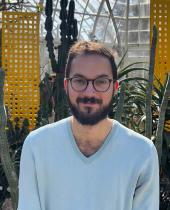
Alex Zivkovic is an art and media historian, interested in ecological media, early cinema, and surrealism. He received his Ph.D. in art history from Columbia University in 2025. He will be a postdoctoral fellow at the Leonard A. Lauder Research Center at the Metropolitan Museum of Art, then in fall 2026, he will start as Assistant Professor in the Art & Art History Department at Hunter College, CUNY. His writings have been published or are forthcoming in the Journal of Cinema and Media Studies, Afterimage, and Nka: Journal of Contemporary African Art, as well as in museum catalogues on Édouard Manet and Remedios Varo. His research has been supported by the Gerda Henkel Foundation, the Buell Center, DFK Paris, the Huntington Library, the Society for French Historical Studies, Dumbarton Oaks, the Stanford-Leuphana Summer Academy, and the Lee MacCormick Edwards Charitable Foundation. More information at: aleksazivkovic.com
His dissertation, "Ambient Empire: Ecologies, Colonies, and Nature Vivante in Modern Paris, 1860–1940" is an art, architecture, and media history of greenhouses, aquariums, and colonial gardens in Paris (c. 1860–1940). Many of these spectacular sites were constructed at Exposition Universelles, world’s fairs that showcased imperial projects and new technologies. Because these simulated environments featured living beings, they required vast imperial networks and complex technological supports in order to keep animals and plants alive as they moved around the globe. Through these three case studies of environmental types, this dissertation narrates the rise of a biopolitics of the nonhuman—a transformation across the French empire that impacted architectural forms and their infrastructures as well as other art and media that similarly tried to capture, sustain, and convey living ecosystems. I focus on the enormous influence of nonhuman life and infrastructural ecologies on modern spectacles in Paris through documentary evidence of these built sites alongside the modernist artworks of impressionist painters, early filmmakers, and surrealists who visited these popular attractions and interrogated their ideologies and effects. Consequently, each chapter also interrogates one major modernist idea—atmosphere, infrastructure, and hybridity, respectively—that was foregrounded within these immersive environments and then debated across diverse fields, showing how art, science, and colonial policy interacted in Paris and overseas.
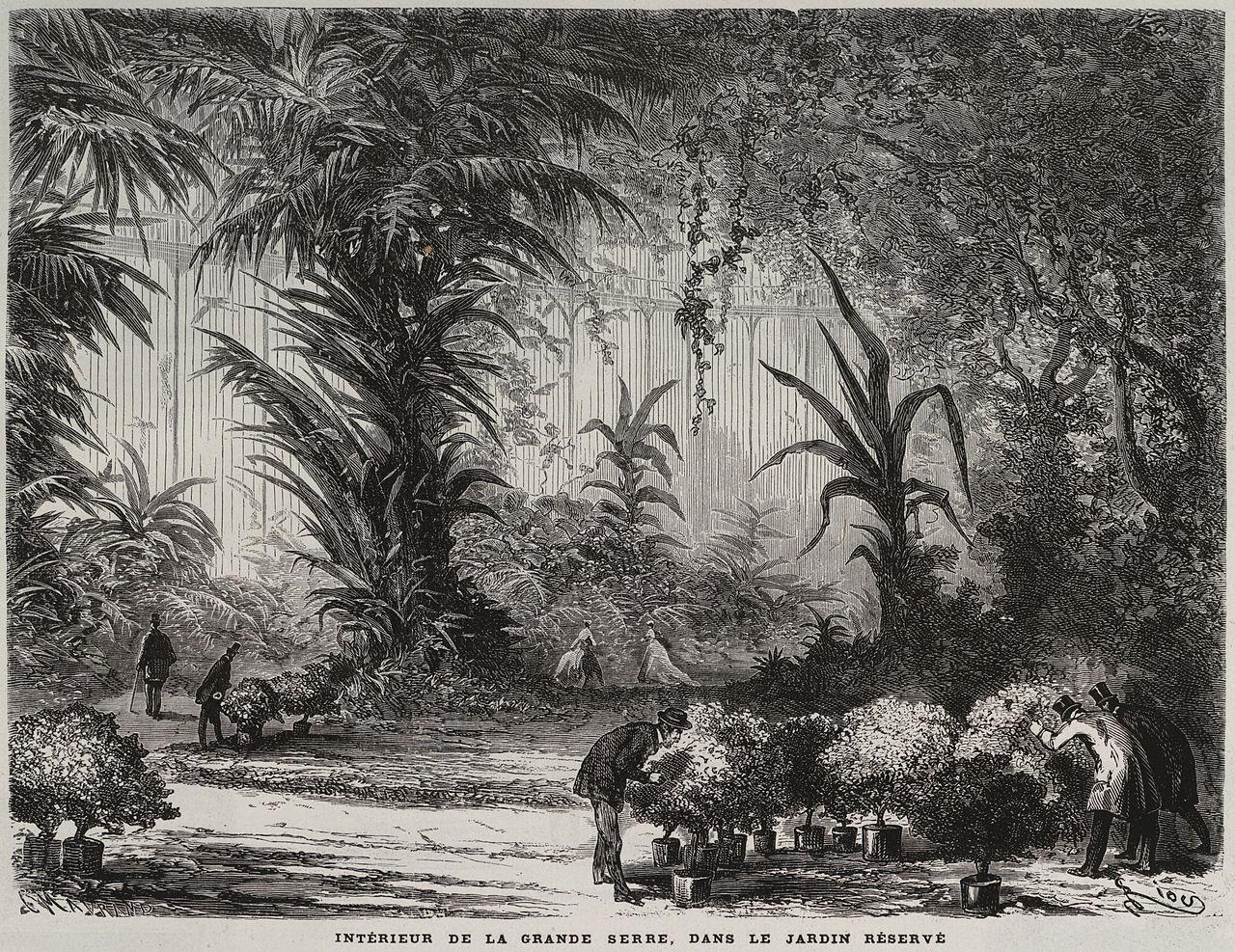
Édouard Riou, “Intérieur de la grande serre dans le jardin reserve,” Grand album de l’Exposition Universelle 1867 (Paris: Michel Levy Frères, 1868)