
“Content, Context and Signification in the Work of Michael Asher,” Journal of Curatorial Studies, 13:2 (2025), 162-179.
 “Ian Burn and the Aporias of Conceptual Art,” Australian and New Zealand Journal of Art, 24:2 (2024), 228-236.
“Integrities: The Salvage of Abu Simbel," Grey Room 50 (Winter 2013), 6-44.
“Rendering: On Experience and Experiment” in Design Technics: Archaeologies of Architectural Practice Ed. Zeynep Çelik Alexander and John J. May. University of Minnesota Press, 2019; 1-44.
"Arrested in the Moment of Dying: Science, Fiction, and the Reality Effect of Reprinting", American Literature, Volume 90, Number 3, September 2018
"Kant’s Magic Lantern: Historical Epistemology and Media Archaeology", Representations, vol. 115, no. 1, 2011
"Psychic Television", Critical Inquiry 31 (Spring 2005)
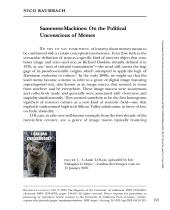
"Sameness-Machines: On the Political Unconscious of Memes" (Representations no. 168, 2024), pages 153–69.
“What Does It Mean To Call Film an Art?” in Rancière and Film, ed. Paul Bowman, Edinburgh University Press, 2013.
“Cinematic Assemblies: Latour and Film Studies.” Latour and the Humanities. Eds. Rita Felski and Stephen Muecke. Baltimore: Johns Hopkins University Press, 2020. 300-327.
 Claudia Breger, "Crowd Choreographies: Spike Lee’s BlacKkKlansman (2018) and the Politics of (Post-)Cinematic Assembly.” Discourse: Journal for Theoretical Studies in Media and Culture 46.2 (2024): 208-27.
“Baroque Out of Focus: The Question of Mediation in Wölfflin,” New German Critique 45.1 (February 2018), pp. 79-109.
“The Larkin’s Architectural Technologies of Trust,” Journal of the Society of Architectural Historians 77.3 (September 2018): 300-318.
"Clock Time," MoMA Magazine, 16 Dec 2024.
“May Day Supermarket: Crisis, Impasse, Medium.” Critical Inquiry, vol. 44, no. 4, June 2018, pp. 745–65.
“Medium Theory; or, ‘The War of the Worlds’ at Regular Intervals.” Current Anthropology, vol. 60, no. 5, Oct. 2019, pp. 656–73. DOI.org (Crossref), doi:10.1086/705345.
Technological indeterminacy: threat, medium, temporality. Anthropological Theory 13(3):267–284.
“AI Imaging, or, The End of Photography and the Affordances of Latent Specificity.” In The World According to AI, edited by Antonio Somaini. Paris: Jeu de Paume, 2025. With Tim Trombley.
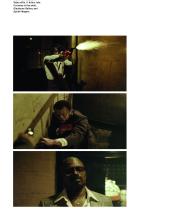
"Arthur Jafa's BG, or, Seeing Race and Visual Truth in the Age of AI," Grey Room no. 100 (2025): 62–89.
 “Counterfactual Speculation: What if Antonia Dickson Had Invented the Kinetoscope?" Feminist Media Histories 8, no. 3 (2022): 3–34.
 “Love and Duty (1931) and the ‘Contradictions of Modernity’” Journal of Chinese Cinemas 18, no 1. (2025)
 “The DH Dilemma: Knowing More & Knowing for Sure vs. Never Knowing At All.” In Doing Digital Film History: Concepts, Tools, and Practices. Ed. Sarah Mai Dang, Tim van der Heijden, Christian Olesen. Oldenberg: De Gruyter, 2024.
“Biomusic,” Grey Room 45 (Fall 2011): 128-150.
“Nose-to-Nose with a Mutant: UFO Photography,” in Imponderable: The Archives of Tony Oursler (Zurich: LUMA Foundation, 2015), 495-501.
Branden W. Joseph, “Something One Recognizes Yet Can’t See: Andy Warhol in and as Media,” Grey Room 77 (October 2019): 6–37.
“Laughter in an Ungoverned Sphere: Comicality in Early Cinema and Web 2.0,” in Paul Flaig and Katherine Groo, eds., New Silent Cinema (AFI Film Reader) (New York: Routledge, 2015), 294-314
“‘The Art of Diddling: Slapstick, Science, and Anti-Modernism in the Films of Charley Bowers,” in Daniel Goldmark and Charlie Keil, eds., Funny Pictures: Animation and Comedy in Studio-Era Hollywood (Berkeley: University of California Press, 2011), 191-210
"Promising Forms: The Political Aesthetics of Infrastructures." InThe Promise of Infrastructure, ed. Nikhil Anand, Hannah Appel and Akhil Gupta eds. (Durham NC: Duke University Press): 175-202.
Techniques of Inattention: The Mediality of Loudspeakers in Nigeria. Anthropology Quarterly 87(4): 989-1
"The Dialectic of the University: His Master's Voice," Grey Room, 60 (Summer 2015) : 82-109.
"Unfolded, Not Opened: On Bernhard Siegert's Cultural Techniques," Grey Room, 62 (Winter 2016): 102-115.
"Destruction or dialectics: Other iconoclasms and the new heritage culture industry." 2020. HAU: Journal of Ethnographic Theory 10 (3): 980-984.
"Mediation, the Political Task: Between Language and Violence in Contemporary South Africa," Current Anthropology 58, no. S15 (February 2017): S123-S134.
"Seeing in the Dark" in For Ever More Images? (Onassis Foundation: 2019).
"Shadow and impress: Ethnography, film, and the task of writing history in the space of South Africa's deindustrialization." History and Theory. 57. 102-125.
'Theses on the New Offentlichkeit,' revise, in English. Grey Room, 51: 94-111.
Filmi Jagat, A Scrapbook: Shared Universe of Early Hindi Cinema. With K Bhaumik and R Allana. New Delhi: Art Heritage & Niyogi Books.
"Somewhere between Human, Nonhuman, and Woman: Shanta Apte’s Theory of Exhaustion," Feminist Media Histories (2020) 6.3: 21–51.
On Cameras, Videos, and Law: Seven Theses and a Meditation on Method. Public Culture 37:3 (September 2025); 307-325. https://doi.org/10.1215/08992363-12175748

Staging Witchcraft Before the Law: Skepticism, Performance as Proof, and Law as Magic in Early Modern Witch Trials (Cambridge University Press, 2024).

The Video and the Algorithm: Democracy, Antitheatricality, and Paranoia in the Age of Streaming Media, Yale Journal of Law & the Humanities, Vol. 35:1 (2024). http://hdl.handle.net/20.500.13051/18508
 "When Taylorism met Revolutionary Romanticism." Critical Inquiry 46 (Spring 2020): 578–604.
“Architecture: Out of Place—Arata Isozaki’s Electric Labyrinth,” in Place and Displacement: Exhibiting Architecture, ed. Thordis Arrhenius, Mari Lending, Wallis Miller and Jérémie McGowan (Zürich: Lars Muller Publishers, 2014): 21-39.
"Earthlike,” Grey Room 65 (Fall 2016): 6-35.
'"She is Shrouded': Some Exploratory Notes on Scaffolding as an Urban Practice." In ARTCHAE: For a Media Ar(t)chaeology of Telepresence, edited by Barbara Grespit et al. Milano University Press, 2026.
"Coming to Terms with the 'Smart Phone." In Technics: Media in the Digital Age, edited by Nicholas Baer and Annie van Der Oever. Amsterdam University Press, 2024.
 "Taxonomy of Techniques Visions of Industrial Cinema in Post-war Japan,” in Films That Work Harder: The Circulation of Industrial Film, eds. Vinzenz Hediger, Florian Hoof, Yvonne Zimmermann, Scott Anthony (Amsterdam: Amsterdam University Press): 249-273.