
With support from University Seminars
Join us for a faculty presentation of a work-in-progress with Ateya Khorakiwala
On Famine Codes, Relief Camps, and the Making of Rural Poverty
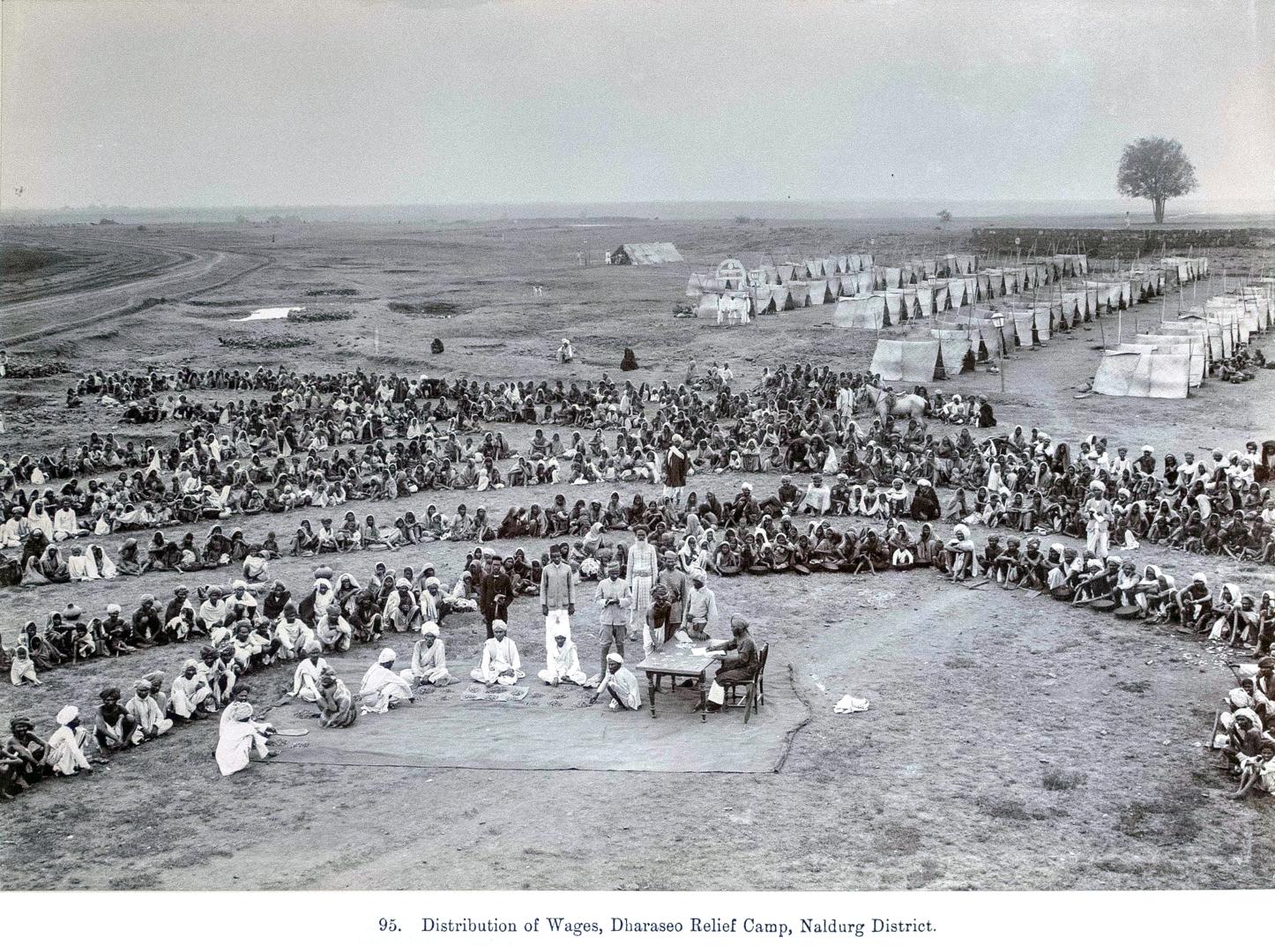
Famine was widespread across the long nineteenth century in rural India. This talk considers an unexpected metabolic relationship between two late-nineteenth century administrative departments—the building codes of the Public Works Department and the famine codes of the Land Revenue Department—in relation to famine relief. The computational logics of the latter were built on the quantitative focus of the former. The resulting architectural and spatial forms prescribed for famine relief works continually tested the capacity of workers to determine their condition of health: on how little food can a body work, survive, or thrive? Architectural techniques enforced utilitarian principles of quantity and time: not too much food, and given not too soon. Mining the archive of documents of famine—inquiry commissions, codes, reports, famine papers, and the diaries and biographies of administrators—this talk argues that public works and famine were intimately intertwined, not in how they counteracted the effects of each other but rather in how they worked together to remake the countryside and the relationship between administration and peasantry in the late nineteenth century up until the end of colonial rule.
Professor Khorakiwala's talk will be followed by a response from Navyug Gill, Associate Professor with the Department of History, Philosophy and Liberal Studies at William Paterson University.
Please RSVP to comparativemedia@columbia.edu to receive the pre-circulated readings (and to receive access to campus, for non-Columbia affiliates).
Ateya Khorakiwala is a historian of modernity in its colonial and postcolonial guises in South Asia; she researched the ways that colonial epistemologies have shaped postcolonial architectural thought. She writes about architecture’s place within the “technocratic assemblage” of architects, engineers, and scientists who shaped India’s postindependence development and planning landscapes, underscoring the political and cultural tensions at play between Cold War technopolitical interests and Indian political elite.
Her book project, Famine Architecture: Forms of Hunger in Colonial and Postcolonial India is a history of the architectural and infrastructural forms that aimed to manage food through technological, administrative, and quantitative means rather than addressing the structural conditions of poverty that created food insecure families in the nineteenth and twentieth centuries. The book analyzes a utilitarian “gray” architecture of silos, warehouses, and plinths, that was called in to manage and protect the value of commodities, mainly cereals and foodgrains. Developing new methodologies to understand the built environment, the book shows how the field of postwar design was produced in the scalar tension between the intimate realm of the hungry body and the national imaginary of a well-fed body politic. Thus, hunger, the book argues, undergirds India’s modernity, and postcolonial modernism reflects the enduring threat of the specter of famine to the material and social body of the postcolonial state.
Khorakiwala has received grants and fellowships from the MacDowell Foundation and the American Institute of India Studies. A newer research project, supported by the Volkswagen Foundation, Making Land in the Age of Urbanization (with co-researchers Alla Vronskaya and Megan Eardley), aims to undertake a comparative history of socialist theories of land and the design of agriculture, rurality, and labor across Mozambique, India, and Central Asia.
Her recent articles include "Granularities: Concrete and the "Gray Architecture" of Grain Storage in India, 1960s-70s" in After Concrete: Rethinking the Dynamics of Material (ed. Allais, Meggers, and Faciejie, Birkhäuser 2026) and "Famine Tracts" in GTA Papers 11: Macroeconomics.
Other essays and articles have appeared in e-flux Architecture: Overgrowth, Comparative Studies of South Asia, Africa and the Middle East (CSSAAME), Grey Room, and the Journal of Architectural Education Architecture in Development (JAE) She has coedited the Aggregate volume Architecture in Development: Systems and the South (Routledge, 2022)(ed. Dutta, Khorakiwala, Levin, Lopez-Duran, Muzaffar); she serves on the board of the Aggregate Architectural History Collaborative. Khorakiwala received her Ph.D. from Harvard University, her MS in Architecture Studies from MIT, and was trained as an architect at the Kamla Raheja Vidyanidhi Institute of Architecture and Environmental Studies in Mumbai, India.