Maur Dessauvage studies eighteenth- and nineteenth-century architecture, with a particular focus
on questions of temporality, secularization, and the survival of myth in European modernity. He
earned his PhD and Master's from Columbia University Graduate School of Architecture,
Planning, and Preservation (GSAPP) and holds a Bachelor of Architecture from Cornell
University. His research has been supported by the Temple Hoyne Buell Center and the Getty
Research Institute, where he was a predoctoral fellow in 2025-2026. Along with Luca Arens and
Hannah Pivo, he organized the first graduate student symposium at the Center for Comparative
Media entitled Ministry and Mystery.
His dissertation, Monuments for a State to Come: Architecture, Historicism, and German Nation-
building, 1814–1871, examines how modern historical attitudes towards architecture, art, and
culture emerged after the collapse of the Holy Roman Empire. In the aftermath of the Napoleonic
Wars, which put an end to the religio-political order of the Holy Roman Empire, German
architects were tasked with creating monuments to a newly imagined "nation" that had not yet
materialized. Although the disparate German lands would remain a fragmentary territorial
constellation until national unification in 1871, Prussian, Bavarian, and Austrian monarchs took
up major architectural commissions to lay claim to the artistic, dynastic, religious, and popular
traditions of the Holy Roman Empire. This project argues that nineteenth-century
historicism—far from neutral and value-free—was profoundly shaped by the sacred imagined
community of the recently dissolved empire. While historicism came to be increasingly accepted
as a purportedly secular and disenchanted view of history by the end of the nineteenth century,
Monuments for a State to Come uncovers the earlier history of a different kind of historicism,
thoroughly imbued with metaphysics, that sought to re-enchant the imperial past with new
meaning.
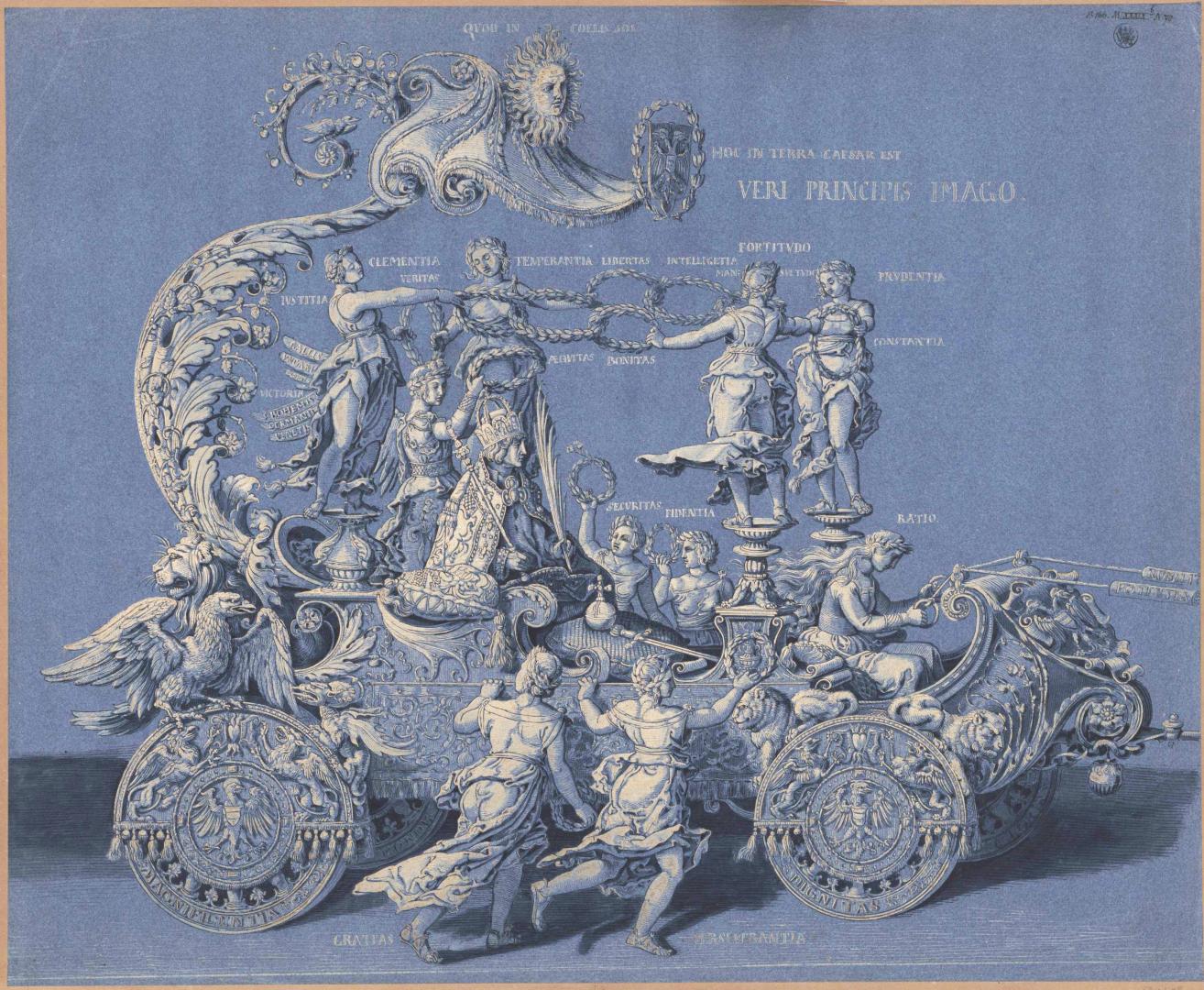
Karl Friedrich Schinkel, Great Triumphal Chariot of the Emperor Maximilian (after Albrecht Dürer), pen and ink on blue paper, 1814-1815