Co-organized by Center for Comparative Media (Columbia) and Film and Media Arts (Temple University).
With support from the Society of Fellows/Heyman Center for the Humanities and the Office of the Dean of Humanities.
Convened by Debashree Mukherjee (Columbia) and Kartik Nair (Temple University).
Click here to RSVP (non-Columbia affiliates who RSVP will receive a QR code to access campus).
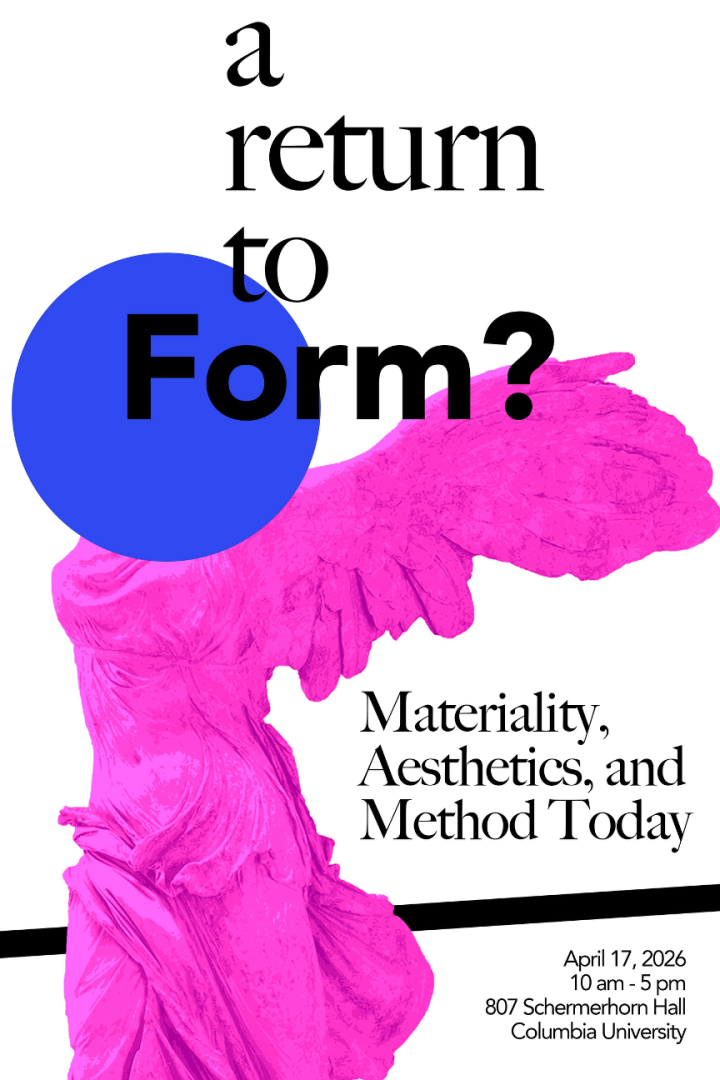
A Return to Form? Materiality, Aesthetics, and Method Today
"Form" has reemerged as a central critical problem in recent years, as scholars re-examine what the humanistic practices of formal analysis, aesthetic description, and close reading can do in the age of machine reading, wearable AI, and continual catastrophe. As traditional formal analysis contends with the distributed, operational, or procedural forms--databases, interfaces, networks, and algorithmic aggregates--a widely polemicized "return to form" has reopened questions of what form is and what formalism does.
While critics accuse formalists of "abandoning the world," proponents argue that reading for form is a way back into politics (a debate that stretches from Raymond Williams and Frederic Jameson to Caroline Levine, Rosalind Krauss, and Eugenie Brinkema). Re-reading form encourages us to consider how strategies of description, surface reading, emphasis, and repair may advance goals previously associated with demystification, depth, criticality, and suspicion (Rita Felski, Sharon Marcus, Heather Love and Stephen Best). Form mediates how meaning and affect circulate in the world, whether form is understood as material structure, as semiotics, or both.
But did form ever really leave the picture?
Building on the Extractive Media conference at the Center for Comparative Media (2024, Columbia University), we invite new approaches to thinking about the material politics of form. A Return to Form? proposes that form has been a tenaciously generative aesthetic-conceptual category that animates several interdisciplinary imaginaries, often in ways that are non-obvious (Anna Kornbluh, Sam Rose). From studies of infrastructure and logistics (Nicole Starosielski, Charmaine Chua, Deborah Cowen), to the "biases" of communications systems and cybernetics, to archaeological histories of new media (Harold Innis, Jussi Parikka, Lev Manovich, Armond Towns), there are multiple traditions within media studies that link poetics with techniques, aesthetics with political economy. Similarly, within critical theory and cultural studies, scholars have parsed forms of historiography, performance, music, and poetry to understand how race, gender, cast, or colonially are re-made or unmade in the world (Courtney Baker, Kajri Jain). This gathering seeks to chart the latent continuities of formalist inquiry across the heterogeneous terrains of history, materiality, ecology, the digital, and the political. We therefore invite scholars of literature, art, visual culture, film and media, and architecture to share what the term "form" materializes for them in their work, and what the so-called re/turn to form offers us collectively.
SCHEDULE OF EVENTS
WELCOME REMARKS | 10–10:30am
Bruno Bosteels, Dean of Humanities (Columbia)
Debashree Mukherjee (Columbia) & Kartik Nair (Temple)
PANEL 1 | Materialities of Form: On Curves and Traces | 10:30–11:45am
Brian Jacobson (CalTech): "Raw Materialism (or, Positivism without Magic)"
Joan Kee (NYU): "Form as Geodesic"
Moderator: Reinhold Martin (Columbia)
PANEL 2 | EXPERIMENTAL FORMS: FROM THE BUREAUCRATIC TO THE STEREOSCOPIC | 12–1:15pm
Brian Larkin (Barnard): "Sophisticated, verbose, inebriated rhetoricians of Empire"
Michael B. Gillespie (NYU): "i ain't afraid no more/ a time to break silence"
Moderator: Julie Peters (Columbia)
LUNCH BREAK | 1:15–2pm
PANEL 3 | CLIMATIC FORMS: HISTORIES AND ITINERARIES OF POWER | 2–3:15pm
Caroline Levine (Cornell): "Adorno is Everywhere, or Why We Need a Formalist Account of Political Power"
Radhika Subramaniam (New School): "Getting Underfoot"
Moderator: Zeynep Çelik Alexander (Columbia)
PANEL 4: DEFORMATIONS: BETWEEN FLATNESS AND FULLNESS | 3:30–4:45pm
Jennifer Fay (Vanderbilt): "Flat is Beautiful"
Ying Qian (Columbia): "Afterlives of Form: The Serfdom of the Xishuangbanna Day (1962)"
Moderator: Kartik Nair (Temple)
CLOSING THOUGHTS | 4:45–5:15pm
PUBLIC RECEPTION | 5:15–6pm
Poster Design: Francis Russo
Graduate Student Coordinator: Hannah Pivo