With support from University Seminars
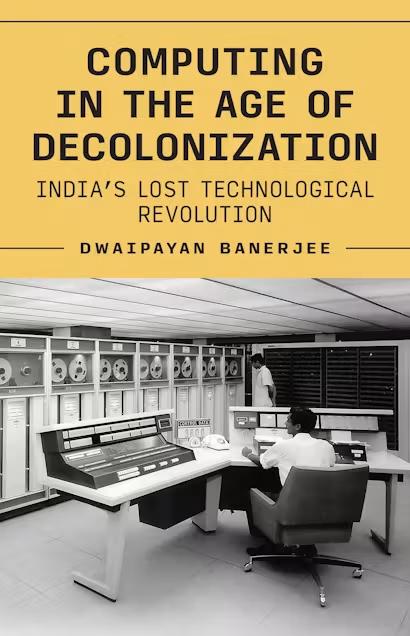
Join us for a book talk by Assistant Professor in the Program in Science, Technology, and Society at the Massachusetts Institute of Technology, Dwaipayan Banerjee on his new work Computing in the Age of Decolonization (Princeton University Press, 2026)
India today is widely recognized for producing world-class tech talent and Silicon Valley leaders, yet captures only a fraction of the global tech industry's profits, primarily providing skilled but inexpensive labor for Western corporations.
Computing in the Age of Decolonization uncovers the overlooked history behind this paradox, tracing India's ambitious but ultimately thwarted drive to build a self-reliant computing industry from the 1950s to the 1980s. After independence in 1947, Indian scientists and policymakers at institutions such as the Tata Institute of Fundamental Research saw computing as central to national sovereignty, economic growth, and scientific advancement. Through projects such as the groundbreaking TIFRAC computer and the decisive expulsion of IBM, they aimed for technological independence.
But almost immediately, these initiatives faced powerful political and economic headwinds. Indian computer scientists grappled with Cold War politics, international trade imbalances, US corporate monopolies, and strategic decisions by India's technocratic elite, who favored profitable technical services over costly investments in research and manufacturing.
In narrating this lost future, Computing in the Age of Decolonization shows that genuine technological independence requires more than technical expertise, it demands addressing enduring political and social structures rooted in colonial legacies. As struggles over computing intensify again, from AI chips and data centers to the question of who may use the most advanced systems, the talk reveals how these same historical pathways continue to shape today's battles for technological and economic sovereignty.
Professor Banerjee's talk will be followed by a response from Alma Steingart Assistant Professor in the Department of History at Columbia University.
Please RSVP to comparativemedia@columbia.edu to receive the pre-circulated readings (and to receive access to campus, for non-Columbia affiliates).
What new perspectives about the history and practice of science, technology, and medicine emerge when we foreground the intellectual labor of thinkers and practitioners from the Global South? Dwaipayan Banerjee's work centers the lives and creative visions of scientific practitioners in South Asia, challenging scholars to reorient how we understand the past and future of science, technology, and medicine. He is an Associate Professor in the Program in Science, Technology, and Society at the Massachusetts Institute of Technology, and the author of Enduring Cancer: Life, Death, and Diagnosis in Delhi (Duke Univ Press), Hematologies: The political life of blood in India (Cornell Univ Press) and Computing in the Age of Decolonization: India's Lost Technological Revolution (Princeton Univ Press, 2026).
This event is supported by the University Seminars at Columbia University and the Society of Fellows and Heyman Center for the Humanities.